Why Private Dental Practices Are Lowering the Percentage Split for Dentists
If you are looking at private dental roles this year, one shift is hard to miss. The percentage split offered to associates, long held around 50 percent of gross private fees, is now more commonly being offered at 40 to 45 percent. It is not universal, but it is common enough that many dentists are seeing it in job adverts and in renewal conversations with their current practice. This article sets out why practice owners are moving that way, so a dentist reading it can weigh up an offer with the full context rather than react to the number in isolation.
This is not only a corporate story. Independent practices are moving in the same direction. The reason sits on the cost side of the practice profit and loss account. Laboratory fees, staffing, employer National Insurance and utilities have all risen, HMRC has changed how associate self-employment is assessed, and the corporate groups that set the benchmarks in the market have consolidated further. Understanding the pressure the practice is under is the first step to negotiating from a position of information rather than resentment.
Key summary at a glance
The historic private split of around 50 percent is now more commonly offered at 40 to 45 percent, particularly to newly joining associates. London and the South East still see the higher end.
Laboratory fees, staffing, utilities and employer National Insurance have all risen sharply, reshaping the practice cost base.
The British Dental Association has reported laboratory fees up around 16.5 percent, staffing up around 15 percent and utilities up around 10 percent, with overall dental-specific inflation of about 9.2 percent.
Employer National Insurance rose from 13.8 to 15 percent from 6 April 2025, and the secondary threshold was cut from £9,100 to £5,000.
HMRC withdrew its long-standing concession on associate self-employment on 6 April 2023. Status is now assessed the general way, using the Check Employment Status for Tax tool.
Corporate consolidation shapes market benchmarks. mydentist, Bupa Dental Care and PortmanDentex together operate well over a thousand practices across the UK and Ireland, setting standard terms that independents reference.
The right way to read an offer is total take-home: what the practice absorbs on laboratory fees, materials, marketing and admin, not the percentage on its own.
What has actually changed
For most of the last two decades, an associate joining a UK private dental practice could expect around 50 percent of gross private fees. Above that was possible for a strong performer or a dentist bringing patients, but 50 percent was the reference point that most agreements were built on.
In 2026 the reference point is lower. Corporates and lower-cost regional markets are now more commonly offering 40 to 45 percent to newly joining associates. Many independents still hold 45 to 50 percent as their base, and stronger markets such as London and the South East continue to see 45 to 55 percent for experienced dentists or specialists. Scotland tends to sit at the lower end. Practices in areas with recruitment challenges will sometimes pay above the range to attract candidates, but the middle of the market has clearly moved down.
The NASDAL Annual Benchmarking Statistics 2025, which draws on data from around 650 principals and limited companies and 600 associates, shows why. Wages and direct costs rose from 45.8 percent of fee income in 2024 to 47 percent in 2025. That is the layer of the practice profit and loss account that includes staffing and associate pay together. Once it starts climbing, the principal has two levers to protect their own margin: raise fees to patients, or tighten the associate arrangement. Most practices are doing a bit of both.
The split is not the only lever practice owners are using. Many are also revisiting how laboratory fees are shared, moving materials from a practice cost to an associate cost, or setting minimum daily production targets. If you are comparing two offers with the same headline percentage, the small print around those items usually decides which is actually the better deal.
The cost stack behind the change
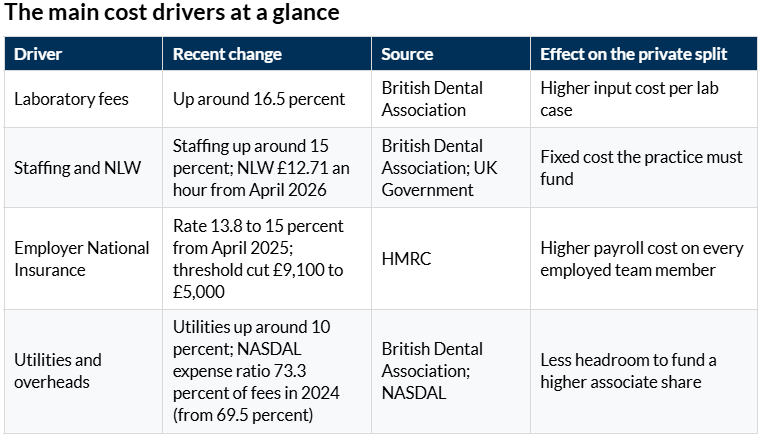
Four cost lines are driving this shift. None on its own is big enough to explain the move, but together they have moved the arithmetic of a private practice in a way that shows up first in the associate split.
Laboratory fees and materials
The British Dental Association has reported laboratory fees rising by roughly 16.5 percent, with dental-specific inflation running at about 9.2 percent. On lab-heavy work such as crown and bridge, dentures and implants, the cost per case has risen faster than fees. If a practice absorbs the full laboratory bill and holds the associate split at 50 percent, the margin on that work can approach zero. Practices are either pushing more of the lab cost to the associate, cutting the split, or both.
Staffing and the National Living Wage
Staffing costs are up around 15 percent according to the BDA. A modern private practice runs on more staff than it once did: nurses, treatment coordinators, hygienists, front-desk and admin, sometimes a practice manager. The National Living Wage rose again on 1 April 2026, with the rate for workers aged 21 and over now £12.71 an hour and larger uplifts for younger workers and apprentices. That is a fixed cost the practice has to cover before profit.
Employer National Insurance
From 6 April 2025, employer National Insurance rose from 13.8 to 15 percent, and the secondary threshold, the point at which employer contributions start, was cut from £9,100 to £5,000. For an employed member of staff on £22,000 a year, that is roughly £770 more each year in employer contributions. For a £50,000 role it adds around £1,100. Multiply that across the average team of six to ten people and the extra sits squarely in the practice overhead.
Utilities and overall overheads
Utility costs are up around 10 percent per the BDA. NASDAL's expense ratio, which tracks total expenses as a share of fee income across UK practices, climbed from 69.5 percent in 2023 to 73.3 percent in 2024. Practices are now spending nearly £3 of every £4 taken in on running the business. When 47 percent of fee income is going to wages and direct costs before that share is even split, the room to fund a 50 percent associate cut has narrowed.
The HMRC self-employed status change
There is another change sitting behind the numbers. On 6 April 2023, HMRC withdrew its long-standing concession that treated associate dentists on standard British Dental Association or Dental Practitioners Association contracts as automatically self-employed for tax purposes. Status is now assessed the same way it would be for any other worker: through HMRC's employment status framework, using the Check Employment Status for Tax tool.
In practice, most well-drafted associate agreements will still support self-employed status. But the risk is no longer theoretical. If HMRC decided an associate was, in substance, an employee, the practice would owe pay-as-you-earn and employer National Insurance contributions going forward. HMRC has said it will not backdate to before 6 April 2023 where practices were correctly following the earlier guidance.
This is affecting the split in two ways. First, practice owners are tightening contract terms to make sure the arrangement clearly evidences self-employment: real substitution rights, associate control over how patients are treated, no fixed hours set by the practice. Second, some owners are using the added exposure as one more reason to reduce the associate share, effectively building a buffer for the new risk. It is not the biggest driver of the trend, but it is a real one.
Corporate consolidation
The corporate groups set the benchmarks for the wider market. mydentist runs over 500 dental practices in the UK. Bupa Dental Care operates close to 500 practices across the UK and Ireland. PortmanDentex has more than 370 practices across the UK and Ireland, with further operations across Europe. Between the three, well over a thousand practices in Britain and Ireland operate on standardised associate terms, and those terms then set reference points that independent practices follow.
Corporate groups have the negotiating power to bring down their laboratory bills and materials costs by buying at scale, and they use that advantage as part of the justification for a lower headline split: the associate gets fewer costs passed on, in return for a lower percentage. Whether that is a fair trade depends on the mix of work and how much the practice absorbs. It is a genuine debate rather than a clean win for either side.
Independent practices are affected even when they do not sell to a corporate. When a corporate offer sits in a nearby market at 42 percent with strong support and marketing, a nearby independent has to reference it when setting its own terms. Consolidation through 2025 has pulled the benchmarks tighter and continues to do so through 2026.
Why this matters
|
Example scenario
The following is a worked example. It is not tied to a specific practice or offer, just a simple illustration to show how the split, laboratory fee arrangement and workload sit together in real numbers. Treat it as a template, not a benchmark.
Imagine an associate billing £15,000 of gross private treatment in a typical month. At the historic 50 percent split, the associate takes home £7,500 before tax. At the current 45 percent that many practices now offer, that becomes £6,750, a £750 reduction each month or roughly £9,000 across a year. At 40 percent, it is £6,000, roughly £18,000 less each year than the old 50 percent benchmark.
Now factor in laboratory fees. If that same £15,000 month is heavy on crowns and dentures, with £2,000 of laboratory fees on the cases, the calculation changes. Under an older arrangement of 50 percent split with the associate paying half the laboratory fees, that is £7,500 minus £1,000 in lab share, leaving £6,500. Under a newer 45 percent split where the practice absorbs the full laboratory bill, the associate keeps £6,750. In that specific scenario, the lower headline split is actually the better take-home.
The point is not that 45 percent is better than 50 percent. It is that the headline percentage on its own is a poor guide to what you will earn. Ask about laboratory fees, materials, consumables, marketing spend on your patients and whether the practice covers indemnity or professional development. Work out the numbers on your realistic mix of work before you accept or reject an offer.
Conclusion
For dentists, the lower private split is not personal and it is not a shortcut. It reflects a real squeeze on practice economics that has built up over the last two years and continued into 2026. Laboratory fees, staffing, National Insurance and utilities have all moved against the practice owner. HMRC has changed how associate status is judged. Corporate consolidation has pulled the market benchmarks tighter. The result is showing up in the associate split.
For the dentist reading a private offer this year, the right response is arithmetic. Take the practice at its word about the percentage, but ask carefully about what it absorbs. Compare offers on total take-home, not on the percentage alone. A well-run private practice is still a strong place to build a career, and a fair 45 percent deal with real support can beat a headline 50 percent that quietly shifts costs onto you.
If you are looking at private dental roles across the UK, the team at Gorilla Jobs UK can help you compare the arithmetic across different practices and set expectations before you interview.
Disclaimer: This blog is a general overview and should not be construed as professional legal, financial or medical advice.
Frequently Asked Questions
What is a normal private percentage split for a UK associate in 2026?
There is no single figure, but the range most commonly offered to newly joining associates is 40 to 45 percent of gross private fees. Stronger markets, particularly London and the South East, still see 45 to 55 percent for experienced dentists or dentists bringing a book of patients.
Why has the split been dropping?
A combination of rising costs (laboratory fees, staffing, utilities), the April 2025 rise in employer National Insurance, the April 2023 change in HMRC's approach to associate self-employed status, and the effect of corporate consolidation on market benchmarks. None of these on its own is decisive; together they have moved practice arithmetic in the same direction.
How does the employer National Insurance change affect associate offers?
Most associates are self-employed and pay their own National Insurance. The practice, though, is now paying more employer National Insurance on every employed team member, from 13.8 to 15 percent from April 2025, with the secondary threshold cut from £9,100 to £5,000. That extra cost sits in practice overhead and reduces the room to fund a higher associate split.
What was the HMRC status change in 2023 and does it affect me?
HMRC withdrew its concession on 6 April 2023 that treated associate dentists on standard BDA or DPA contracts as automatically self-employed. Status is now assessed the same way it is for any other worker, using HMRC's employment status framework. Most well-drafted associate agreements still support self-employment, but the risk has moved from theoretical to real, so practices are more careful with their contracts.
Do corporates pay differently from independents?
Corporates typically use standardised terms and often offer a lower headline percentage with more of the costs absorbed at scale. Well-run independents can be more flexible on both sides. The best comparison is total take-home, not the headline percentage.
Should I ever accept a split under 40 percent?
It depends on what sits around it. A 38 percent split with laboratory fees, materials and marketing fully covered, strong appointment support and a busy private book can produce a better net than a 50 percent split at a struggling practice. Do the maths on realistic monthly billings and what each side absorbs before you decide.
Information Sources
Patient Plan Direct, Counting the Cost: How Rising Expenses Are Squeezing Dental Practices
Practice Plan, Why the numbers are adding up for private practice owners
Dental Elite, Employer's National Insurance Contributions and the dental market
Hill Dickinson, Change in HMRC guidance on self-employed status for associate dentists
RSM UK, HMRC updated guidance on self-employed status of Associate Dentists
British Dental Association, HMRC and associate self-employment
Bishop Fleming, Dental associates brace for impact of employment status changes
Dentistry.co.uk, National insurance: how can practice owners tackle rising costs?